At MWC Barcelona 2026, CTTC showcases a new generation of experimental infrastructures designed to accelerate the path toward 6G. The lineup includes Zero Touch Experimentation platforms delivering Experimentation as a Service, AI native RAN testbeds and advanced digital twin simulation environments.
These capabilities enable industry and the research community to validate new architectures, AI algorithms, and communication and sensing services in representative, reproducible, and collaboration‑ready environments.
Plaza6G: Zero‑Touch AI Experimentation for Next‑Generation Networks
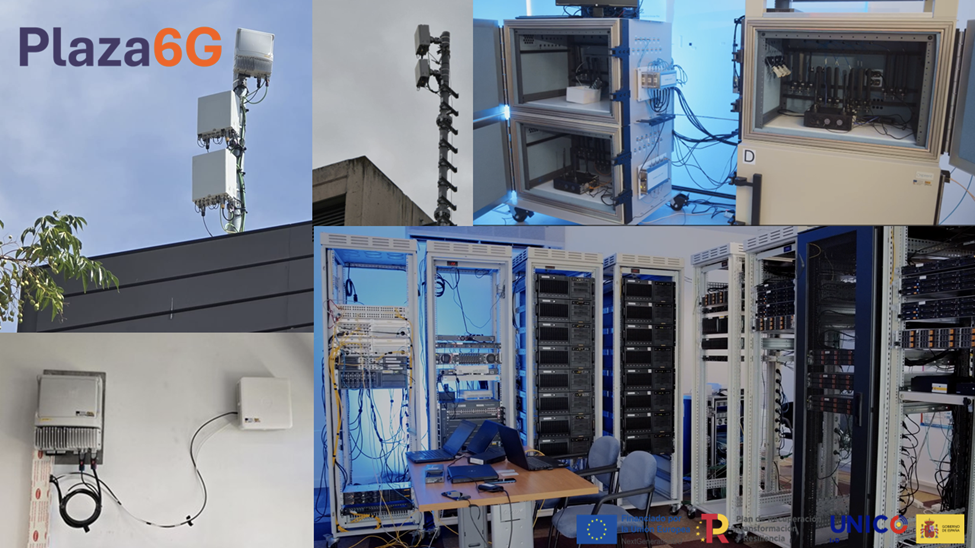
Plaza6G is an open, AI‑assisted telco cloud infrastructure that delivers Experimentation‑as‑a‑Service to accelerate the development of next‑generation network products and services. Building on CTTC’s EXTREME Testbed® with sub‑6 GHz and mmWave networks, O‑RAN support and enhanced computing resources, it enables fully automated test campaigns across indoor and outdoor setups, both over‑the‑air and in anechoic chambers, through a Zero‑Touch web portal and API.
CTTC introduces Plaza6G, an open, AI-assisted Experimentation-as-a-Service telco cloud infrastructure designed to accelerate the development of next-generation network products and services. Open to industry and academia, Plaza6G enables fully automated testing and seamless integration within the development cycle.
Plaza6G extends CTTC’s EXTREME Testbed® with new indoor and outdoor communication networks operating in sub-6 GHz and mmWave bands, O-RAN support, AI-assisted testing in fully monitored environments, and enhanced computational capacity. Together, these capabilities make Plaza6G an ideal framework to validate advanced AI solutions aligned with the Intelligent Infrastructure and ConnectAI visions.
At its core, Plaza6G delivers Zero-Touch Experiment-as-a-Service, offering an intuitive web portal (www.plaza6g.eu) and API that allow users to focus on what they want to test—such as a vertical application—while the platform automatically integrates and executes experiments across configurable next-generation mobile network setups (indoor/outdoor, sub-6/mmWave, over-the-air or anechoic chamber). The AI-assisted interface provides continuous oversight of the experiment lifecycle, from deployment to teardown.
Plaza6G acts as an open innovation hub where high-performance, network-intensive use cases can be rapidly tested and validated through a simple, user-friendly framework. The platform was developed under the Plaza6G and Plaza6G+ projects, funded by Next Generation EU (UNICO I+D), with a total investment of 4 M€.
Advanced 6G AI-Native testbed O-RAN compliant
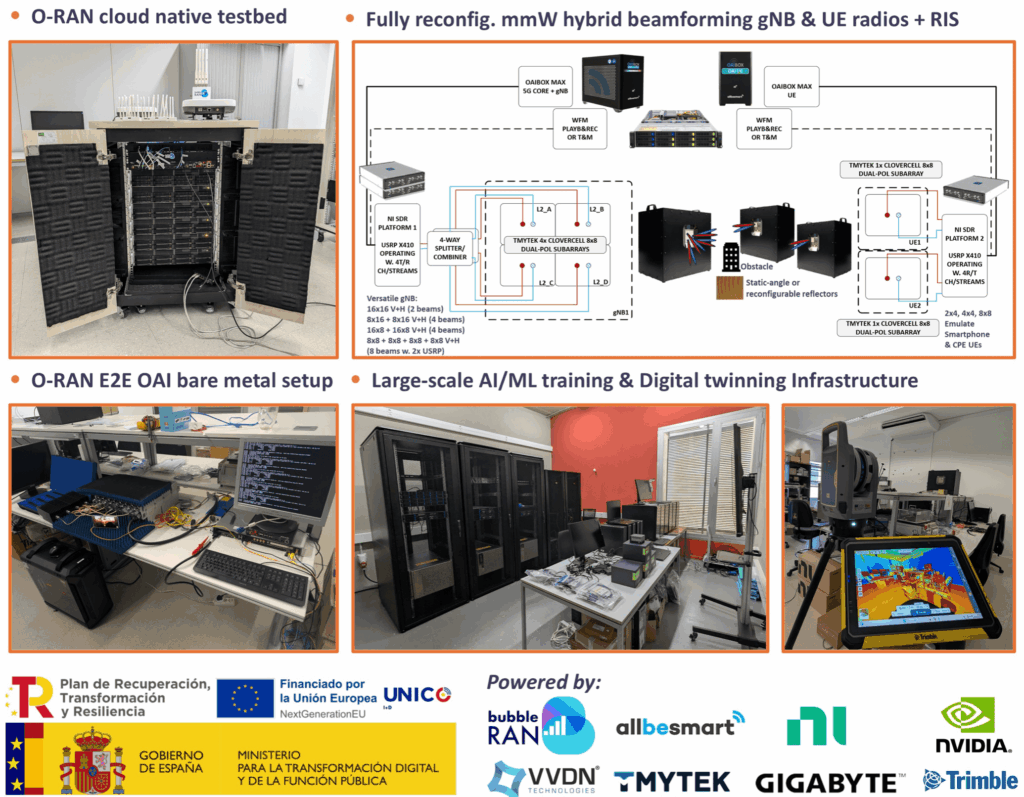
CTTC’s 6G AI‑Native testbeds provide an end‑to‑end, O‑RAN‑compliant experimental infrastructure for research on AI‑driven RAN technologies. The platform integrates carrier‑grade servers, high‑performance accelerators, fronthaul switching, Open5GS and OAI cores, dual near‑RT and non‑RT RICs for xApps and rApps, along with mmWave hybrid‑beamforming transceivers, antenna arrays, a high‑performance GPU cluster, and NVIDIA Aerial Omniverse‑based digital twin capabilities for realistic emulation and AI training.
CTTC is advancing future connectivity with end-to-end 6G experimental infrastructure for AI-native RAN technologies. This O-RAN compliant platform integrates carrier-grade servers, high-performance accelerators, and fronthaul switching, orchestrated by Kubernetes and supporting Open5GS and OAI cores with dual near-RT and non-RT RICs for AI/ML-driven xApps and rApps. From RF-shielded to over-the-air validation, with observability via Grafana and Prometheus and access to low-PHY FPGA design and O-RUs, it enables rapid prototyping of next-generation radio and disaggregated network functions.
The infrastructure includes mmWave hybrid beamforming transceivers and antenna arrays, enabling research on energy-efficient architectures via digital linearizers, and sensor- and RIS-aided beamforming. A high-performance GPU cluster supports large-scale AI/ML operations and digital twin simulations. Integrating a 3D laser scanner reality capture and the NVIDIA Aerial Omniverse Digital Twin (AODT), the platform enables realistic emulation and AI training.
This platform was deployed in the projects EMERGE6G (TSI-064100-2022-015) and IMMERSE6G (TSI-064100-2023-25) funded within the UNICO I+D 6G programme by the Ministerio para la Transformación Digital y de la Función Pública under the Next Generation EU Recovery and resilience plan for Spain.
Watch this video to learn more about its use in the HEU SNS JU VERGE project.
EMERGE6G: Bringing Future 6G Technologies to Life
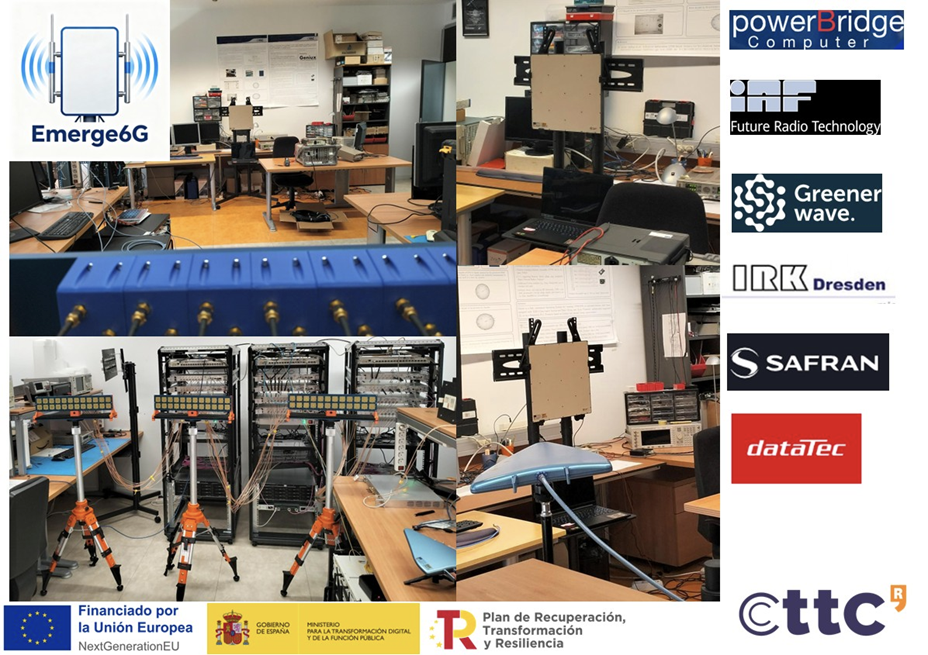
The EMERGE6G experimental platform, hosted at CTTC’s ISPIC laboratory, provides a versatile environment to transform ambitious 6G concepts into real‑world demonstrations. Combining a scalable SDR platform with dozens of RF chains, sub‑6 GHz antenna panels, massive and XL‑MIMO architectures, reconfigurable intelligent surfaces and sub‑nanosecond synchronization based on GPS and White Rabbit, it enables the design and validation of joint communication and sensing schemes for context‑aware future networks.
The ISPIC laboratory at CTTC now hosts a cutting-edge experimental platform designed to transform ambitious 6G concepts into real-world demonstrations. Developed within the EMERGE6G project, the platform provides a versatile environment for researchers and industry to explore how future wireless networks will connect people, machines, and intelligent environments.
The infrastructure enables the design and validation of advanced 6G technologies, including large antenna arrays, massive and XL-MIMO, distributed and cell-free MIMO architectures, and joint communication and sensing for context-aware networks.
EMERGE6G integrates a set of key technological building blocks: a scalable Software Defined Radio (SDR) platform with multiple units and dozens of RF chains managed by high-performance servers over a high-speed network; antenna panels operating in sub-6 GHz bands such as 2.4 and 3.5 GHz; reconfigurable intelligent surfaces in FR1 and FR2 bands to control radio-wave propagation; and high-precision synchronization based on GPS and White Rabbit technologies, providing sub-nanosecond timing accuracy.
Industry fuels 5G-LENA’s evolution towards 6G-LENA
5G‑LENA is an open‑source research simulator that, in close collaboration with leading industry players and organisations such as InterDigital, Meta, Cisco, NIST, and others, has become a reference tool for 5G network studies. Its evolution towards 6G‑LENA brings 3GPP‑compliant and calibrated SU‑MIMO models, Sionna‑powered ray tracing, advanced traffic and mobility models, and joint TN/NTN support, positioning the framework as a key digital twin platform for 5G/6G, O‑RAN, V2X, spectrum sharing, and Industry 4.0 scenarios.
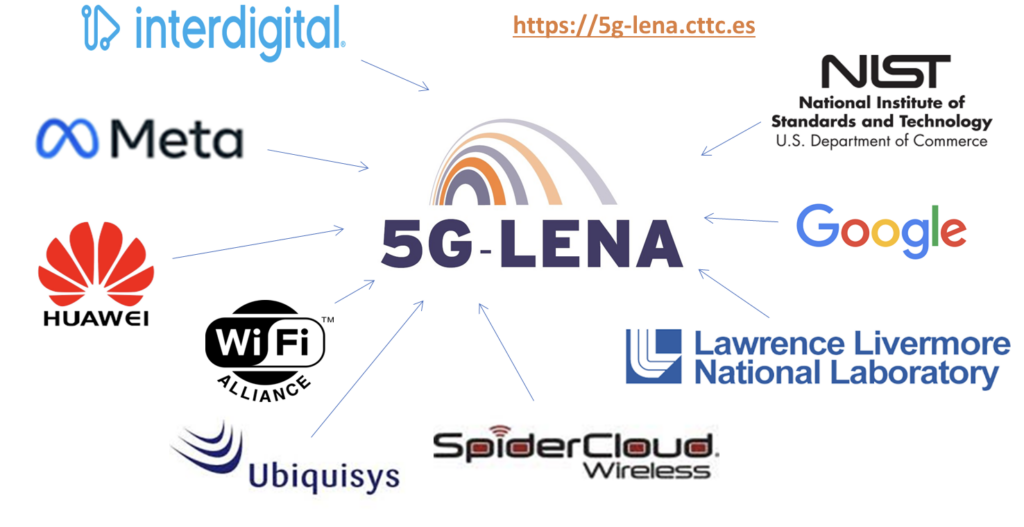
Over the last decade, 5G-LENA has been developed by CTTC as an open-source research simulator in tight collaboration
with market-leading industry players, such as InterDigital, Meta (formerly Facebook), Cisco (via Ubiquisys), the Wi-Fi Alliance, SpiderCloud Wireless (Corning Incorporated), NIST, Huawei, and Google (via Google Summer of Code), among others.
In 2025, 5G-LENA reached an important milestone with 3GPP-compliant and calibrated SU-MIMO models, including rank/precoding-related selection algorithms and feedback support, strengthened integration paths with the ns-3 AI module, and channel models to support scalable digital-twinning-style studies.
In 2026, we plan to release 5G-LENA 5.0, adding support for Sionna Ray Tracing integration (powered by Nvidia), enhanced traffic and mobility realism models, RRC handover, and establishing a strong baseline for integrated terrestrial (TN) and non-terrestrial (NTN) simulations. 5G-LENA is quickly evolving to become one of the leading Digital Twin frameworks for 5G/6G, O-RAN, AI data sets, NTN, V2X, spectrum sharing, and Industry 4.0.