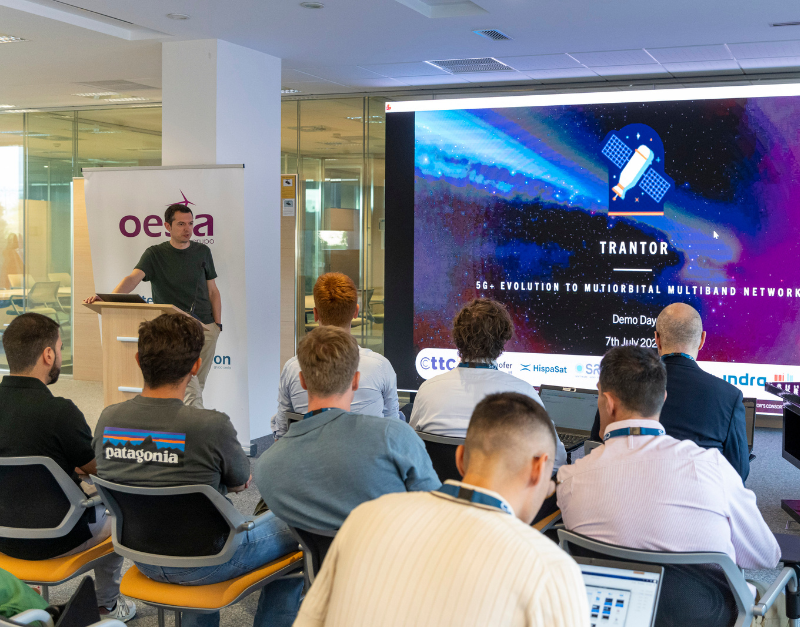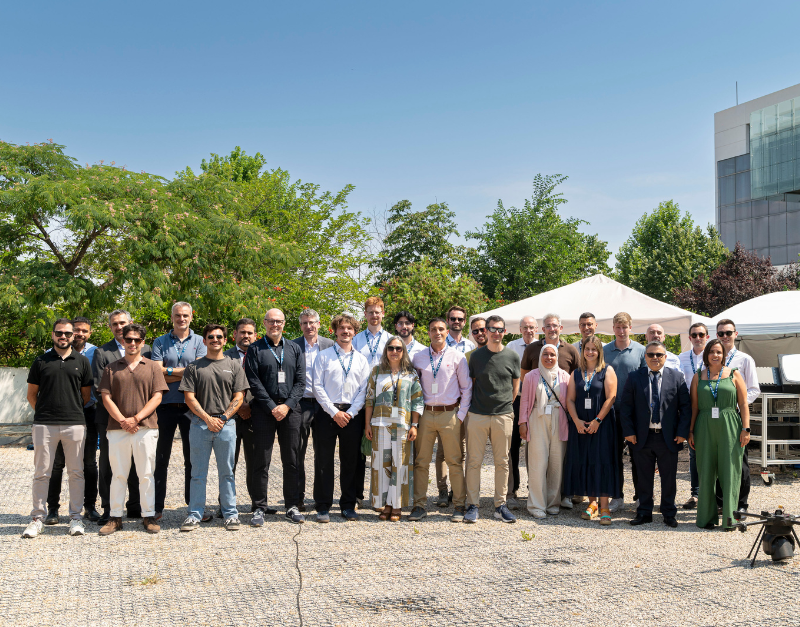
The final demonstrations of the Horizon Europe TRANTOR project confirmed the feasibility of 5G-based satellite multi-connectivity across Ku and Ka bands, across multiple GEO satellites, and between a GEO satellite and a LEO-like link emulated with a drone.
CASTELLDEFELS, 8 July 2026. The European TRANTOR project — 5G+ evolution to multi-orbit, multi-band and multi-satellite networks — has successfully completed its final set of demonstrations, validating key technologies for the evolution of 5G Advanced and pre-6G non-terrestrial networks.
Coordinated by the Telecommunications Technology Centre of Catalonia (CTTC), TRANTOR has brought together leading European research organisations, satellite operators, technology providers and industrial partners to study, develop and experimentally validate a new generation of satellite communication systems based on 5G NTN principles.
The final three demonstrations addressed one of TRANTOR’s core objectives: validating multi-connectivity for future satellite networks in real field conditions, using operational commercial satellite infrastructure rather than laboratory-only environments. The experiments demonstrated that a 5G NTN user terminal and its supporting network infrastructure can support connectivity transitions across Ku and Ka bands, across multiple GEO satellites, and between a GEO satellite and a LEO-like access link emulated through a drone-based platform. This field validation is particularly relevant because the successful satellite experiments relied on commercially available satellite capacity already in operation.
The first of these demonstrations validated multi-band connectivity between Ku and Ka satellite links. The experiment showed that a user terminal can operate in a scenario where different frequency bands are available and where the network can manage the transition between them. This is a relevant step for future satellite systems, where service continuity, spectrum availability and traffic steering may require the use of several frequency bands within the same end-to-end 5G NTN architecture.
The second demonstration addressed multi-satellite connectivity between GEO satellites. In this case, TRANTOR validated mechanisms that allow the network to consider more than one GEO satellite as part of the connectivity architecture. This capability is important for future satellite networks in which coverage, capacity, resilience and service availability may depend on the coordinated use of multiple satellite resources rather than on a single satellite link.
The third demonstration extended the validation to a multi-orbit scenario, combining a GEO satellite link with a LEO-like link emulated through a drone. This demonstration allowed the consortium to test connectivity procedures in a controlled field environment where a non-geostationary access component could be reproduced without requiring a live LEO satellite. The result is an important experimental milestone towards future integrated GEO–LEO 5G NTN systems.
Together, these demonstrations confirm the technical feasibility of the multi-band, multi-satellite and multi-orbit concepts developed within TRANTOR. They also show the value of combining real satellite infrastructure, experimental 5G NTN user equipment, software-defined radio platforms, drone-based emulation and intelligent network management tools in a single validation framework.
“TRANTOR has demonstrated that 5G NTN is not only a theoretical evolution of satellite communications, but a practical architectural path towards more flexible, resilient and integrated satellite networks,” said Dr. Pol Henarejos, TRANTOR coordinator at CTTC. “The success of the final demonstrations is particularly relevant because it validates multi-connectivity in realistic conditions, across frequency bands, multiple satellites and a GEO–LEO scenario emulated with a drone.”
Over the course of the project, TRANTOR has worked on the design and validation of a compatible multi-orbit, multi-band and multi-satellite architecture for 5G Advanced and pre-6G satellite networks. The consortium has developed and integrated experimental user terminals, base station components, satellite access infrastructure, AI-based resource management tools, mission planning capabilities and security mechanisms adapted to future NTN deployments.
The project results provide a concrete experimental basis for the gradual convergence between terrestrial mobile network technologies and satellite communication systems. This convergence is expected to support new services in areas where terrestrial coverage is limited, unavailable or insufficient, including mobility, emergency communications, maritime and aeronautical connectivity, remote industrial operations and direct-to-device applications.
TRANTOR is funded by the European Union under the Horizon Europe programme and involves CTTC, Consiglio Nazionale delle Ricerche, Fraunhofer Institute for Integrated Circuits IIS, Hispasat, Indra, Inster, Quadsat, Software Radio Systems, Starion and the University of Luxembourg.
TRANTOR is a Horizon Europe research and innovation project focused on the evolution of 5G Advanced and pre-6G satellite networks towards multi-orbit, multi-band and multi-satellite architectures. The project addresses the integration of satellite communication systems with 5G NTN technologies, combining experimental validation, network management, satellite mission planning, security analysis and field demonstrations.
The Telecommunications Technology Centre of Catalonia (CTTC) is a non-profit research institution based in Castelldefels, Barcelona, created through a public initiative of the Government of Catalonia. CTTC conducts fundamental and applied research in communication networks, communication systems, communication technologies and geomatics, with strong participation in European research programmes and advanced experimental platforms for future communication systems.