
Next‑generation networks will rely on tightly integrated radio, optical and transport layers that are scalable, energy‑efficient and automation‑ready by design. CTTC is helping define this foundation through advanced multiple access techniques for 6G, intelligent optical networking for AI data centers, and the ETSI TeraFlowSDN controller for autonomous transport networks.
From ETSI to 3GPP: CTTC to Boost 6G Spectrum Efficiency via Advanced Multiple Access Techniques
Within the ETSI ISG MAT, CTTC leads key activities on downlink multiple access techniques to address 6G spectrum efficiency under tight spectrum constraints. By independently implementing and cross‑validating simulations for schemes such as NOMA and RSMA across hotspot, urban macro and rural scenarios, CTTC provides robust evidence that feeds directly into 3GPP RAN1 studies via the GR MAT 001 report and associated liaison statements.
CTTC plays a leading role in the ETSI Industry Specification Group on Multiple Access Techniques (ISG MAT), a key pre-standardization initiative addressing a central 6G challenge: improving spectral efficiency under tight spectrum constraints. Relevant deployment environments considered in the ISG MAT are indoor hotspot, urban macro (e.g., High Demand Density areas) and rural settings. As a founding member, CTTC collaborates with major industry and research partners to evaluate advanced downlink multiple access techniques, including Non-Orthogonal Multiple Access (NOMA) and Rate-Splitting Multiple Access (RSMA).
A core contribution from CTTC is the independent implementation and cross-validation of simulation results, ensuring robustness, reproducibility, and technical consensus among participants. This effort has been critical to establishing confidence in the comparative performance assessment of candidate techniques against existing 3GPP solutions.
The group’s work culminated in the first ETSI Group Report, GR MAT 001 v1.1.1 – Multiple Access Techniques for Spectral Efficiency Enhancement, released in January 2026. Its results are being fed into 3GPP RAN Working Group 1 via a liaison statement for RAN1#124 in 2026, supporting ongoing 6G physical-layer studies. Through this contribution, CTTC strengthens its position as a trusted scientific reference in global 6G standardization.

CTTC Drives Global Standards for Optical Networks in AI‑Optimized Data Centers
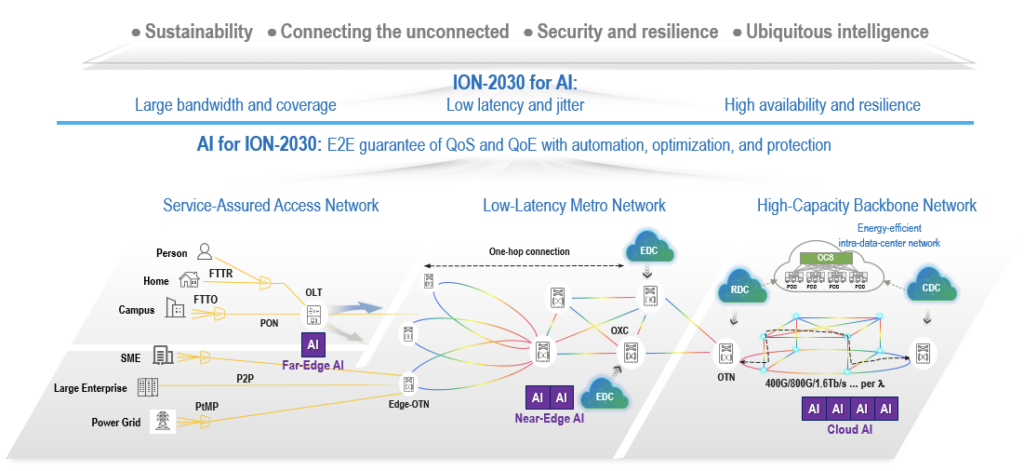
As co‑editor of the ITU‑T technical report TR ION aiDC, CTTC helps define intelligent optical networking architectures for AI‑enabled data centers, covering DCI, DCN and DCA domains. The work analyses how AI workloads reshape bandwidth, latency, synchronization and reliability requirements, and identifies optical circuit switching, high‑capacity coherent transmission and energy‑efficient photonic integration as key enablers for scalable, sustainable AI infrastructures.
CTTC is playing a key leadership role in the evolution of global optical network standards as co‑editor of the newly launched ITU‑T technical report on intelligent optical networking architectures and mechanisms for AI-enabled data centers (TR ION aiDC).
The TR identifies the requirements, scenarios, and enabling technologies across data center interconnection (DCI), intra‑data center networks (DCN), and data center access (DCA), placing strong emphasis on optical circuit switching, high‑capacity coherent transmission, and energy‑efficient photonic integration. It also analyses how AI workloads reshape bandwidth, latency, synchronization, and reliability demands across the optical stack.
By contributing to this strategic initiative, CTTC reinforces its commitment to advancing international standards and accelerating the deployment of intelligent, scalable, and sustainable optical infrastructures for AI‑driven computing environments. The report marks a significant step toward harmonizing global research and industry practices under the ITU‑T ION‑2030 vision.
Building the Foundation for Autonomous Transport Networks with ETSI TeraFlowSDN
Led by CTTC, the ETSI TeraFlowSDN community is advancing an open‑source SDN controller that brings policy‑driven, closed‑loop automation to next‑generation transport networks. Release 6 introduces enhanced IP‑optical convergence, SIMAP‑based observability for network digital twins and integrated Quantum Key Distribution, enabling resilient, high‑capacity and sovereignty‑aware infrastructures for future 6G services.
The ETSI TeraFlowSDN (TFS) community, led by CTTC, presents its latest advances in autonomous network orchestration, marking a key milestone for Europe’s 6G ambitions. This year’s showcase highlights the successful deployment of Release 6 and the outcomes of the ETSI SNS4SNS 2026 event, reinforcing TeraFlowSDN’s position as a leading open-source SDN controller for future hyper-connected and intelligent infrastructures.
Release 6 provides a programmable foundation for next-generation transport networks, introducing policy-driven closed-loop automation that enables real-time self-configuration based on live telemetry. A major advancement is enhanced IP-Optical convergence, integrating technologies such as Flexgrid lightpaths and OpenROADM to deliver a unified, intelligent control plane for complex, multi-vendor environments. The release also strengthens security and observability through the integration of the IETF-aligned SIMAP connector, enabling high-fidelity Network Digital Twins for predictive maintenance and safe testing. In addition, Release 6 advances digital sovereignty with built-in Quantum Key Distribution (QKD) integration.
As the TeraFlowSDN community emphasizes, the platform moves beyond connectivity toward a unified ecosystem combining compute, AI, and networking. During MWC 2026, CTTC experts will demonstrate how these open-source capabilities are enabling resilient, high-capacity infrastructures for the next decade of telecommunications.