Industrial AI, quantum computing and next‑generation fixed networks demand security and trust models that go far beyond traditional ICT certification. CTTC is contributing to this transformation through unified cybersecurity certification frameworks for Industrial AI and Quantum, advanced F5G architectures with built‑in energy efficiency, and key ETSI standards supporting Europe’s Cyber Resilience Act.
Pioneering the Future of Certified Trust in Industrial AI and Quantum Computing
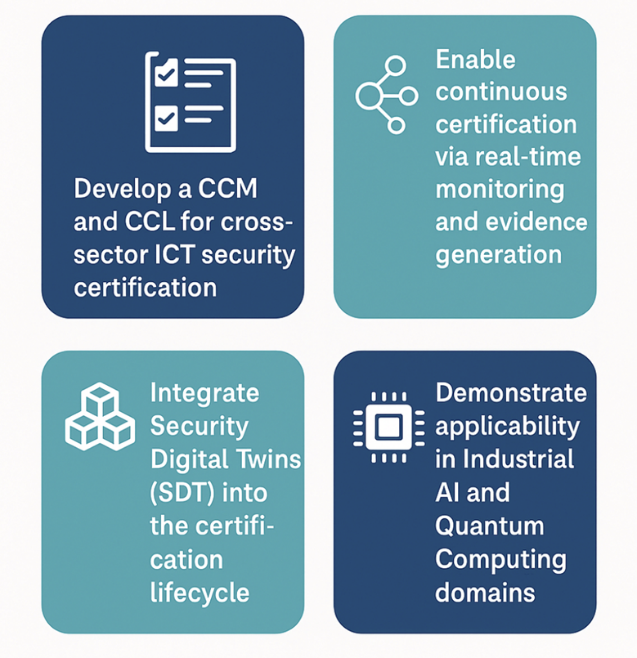
Within the Horizon Europe COBALT project, CTTC is validating one of the first unified cybersecurity certification frameworks covering both Industrial AI and Quantum domains, aligned with EUCS and upcoming European schemes. By integrating tools such as cloud‑level collectors and AI assessment modules, and trialling them on real‑world AI‑vision and quantum applications, the framework shows how security can be treated as a measurable, auditable property across complex industrial systems.
The CTTC and the COBALT project (Horizon Europe) have reached a major milestone in European digital sovereignty: the successful validation of the first unified cybersecurity certification framework for Industrial AI and Quantum domains. In the IQ Era, COBALT closes the trust gap by demonstrating how complex, composite systems can be holistically certified in alignment with EU Regulations, such as the EU Cybersecurity Certification Scheme (EUCS).
This validation phase proves that security is a measurable, certifiable metric rather than a bolt-on feature. By integrating diverse ecosystem components, including cloud-level collectors like Clouditor and AI assessment tools like AIShield, the project provides a unified perspective for evaluating industrial systems. A key success includes a real-world AI-vision system for defect detection, where the framework allows auditors to visualize non-compliances in real-time using the EUCS AI Extension Profile.
Furthermore, the project demystifies the next frontier of computing with a Quantum Search Application. This allows IT owners to verify quantum process security without requiring deep physics expertise, making the domain accessible for industrial use. These insights are continuously cycled back to refine technical requirements, ensuring COBALT’s framework provides the “seal of approval” necessary for the future of European industrial trust and international standardization.
CTTC Leads the Path to Intelligent and Green F5G Networks
As Rapporteur of ETSI DGS/F5G‑0027, CTTC is defining the end‑to‑end management and control architecture for F5G Advanced, enabling autonomous, intent‑driven and energy‑efficient fixed networks. The specification introduces hierarchical orchestration, multi‑domain coordination and explicit energy‑efficiency management across customer premises, access, aggregation and core segments, supporting sustainable broadband and cloud‑native services.
CTTC continues strengthening its role in global fixed‑network standardization through the leadership of DGS/F5G‑0027, a key work item of the ETSI ISG F5G initiative. As Rapporteur of this specification, CTTC has contributed to defining the End‑to‑End Management and Control Architecture for F5G Advanced, setting the foundations for autonomous, intent‑driven, and energy‑efficient fixed networks.
The newly published ETSI GS F5G 027 V1.1.1 (2025‑12) report specifies the functional architecture, interfaces, and domain controllers that enable full automation across Customer Premises, Access, Aggregation, and Core segments. It enhances previous F5G releases by introducing hierarchical orchestration, multi‑domain coordination, advanced E2E service fulfilment, and incident‑based assurance mechanisms.
A major innovation in this work is the inclusion of energy‑efficiency management, enabling distributed monitoring, analytics, and optimization across network domains to support sustainable F5G deployments. The report also consolidates intent‑driven NBIs, closed‑loop automation, ZSM‑aligned orchestration, and slicing capabilities to meet the needs of high‑value broadband, enterprise, and cloud‑native services.
Through this contribution, CTTC reinforces its long‑standing leadership in next‑generation optical networking and its commitment to driving ETSI’s vision for F5G Advanced: autonomous, greener, and more intelligent fixed networks.
CTTC at the Core of ETSI Cybersecurity Standards for Europe’s Cyber Resilience Act
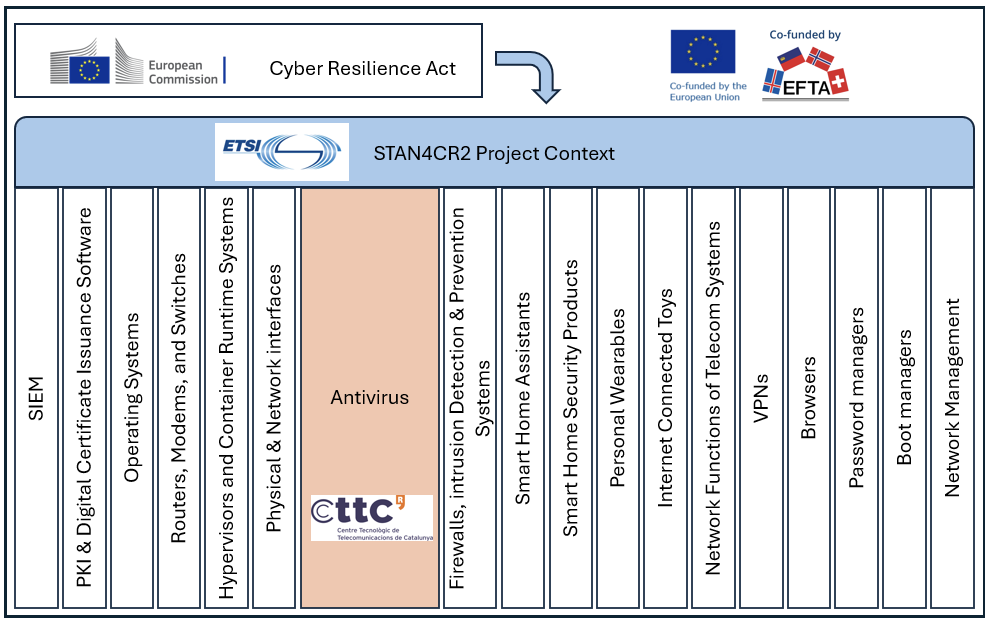
Through the STAN4CR2 project, CTTC is leading the development of a harmonised ETSI standard on cybersecurity requirements for antivirus and antimalware products, directly supporting implementation of the EU Cyber Resilience Act. The work defines realistic use‑case‑driven risk assessment, structured evaluation methodologies and evidence requirements, and opens the process to global stakeholders via public review of draft specifications.
The Centre de Telecomunicacions de Catalunya (CTTC) is leading the development of a new harmonized standard on cybersecurity requirements for antivirus and antimalware products, recently presented in a Deep Dive Session available at CRA Standards Unlocked: Deep Dive Session on Antivirus | Stan4CR. This work is part of the STAN4CR2 project, funded by the EU and EFTA, which spans multiple verticals—including browsers, operating systems, and network management systems—under ETSI support and European Commission guidance, with contributions from international cybersecurity experts.
The draft standard emphasizes well-defined use cases as the basis for risk assessment, security requirement identification, and conformity evaluation. These use cases reflect realistic deployment scenarios, from consumer environments to critical infrastructures, ensuring alignment between requirements and operational context. The specification also defines structured assessment methodologies, covering preparation activities, testing approaches, and required evidence.
CTTC stresses the importance of broad stakeholder participation, as the draft is now publicly available for comment ahead of formal approval by European National Standardisation Organisations. Organizations worldwide are invited to contribute not only to the antivirus and antimalware vertical, but also to other ETSI developments available at https://gitlab.com/etsi/STAN4CRA, helping shape future cybersecurity compliance across Europe.